Key Takeaways
|
Most people think that glasses are the simple part of eye care. But the slip from the eye test looks like a code. In a review of Indian studies on adults above 30 years nearly 1 in 3 had uncorrected presbyopia and about 1 in 10 had an uncorrected refractive error (Sheeladevi et al. 2019).
People get confused when they see the eye prescription slip. There are short words like SPH and CYL and axis and ADD. There are plus and minus numbers. And the numbers for the right and the left eye are often different. Many people just hand over the slip to the optician. It is better to know what the prescription says.
In this blog we explain how to read an eye prescription. We cover SPH in the eye test and CYL in the eye test, axis in the eye test and ADD. We also show an eye power chart so that you know what your number means and what to ask your eye doctor.
Not sure what your prescription means?
What Is an Eye Prescription?
An eye prescription is the written result of your eye test. It tells the optician the power of the lens that your eyes need. This power is measured in a unit called diopter or D. The numbers are usually written in steps of 0.25 D.
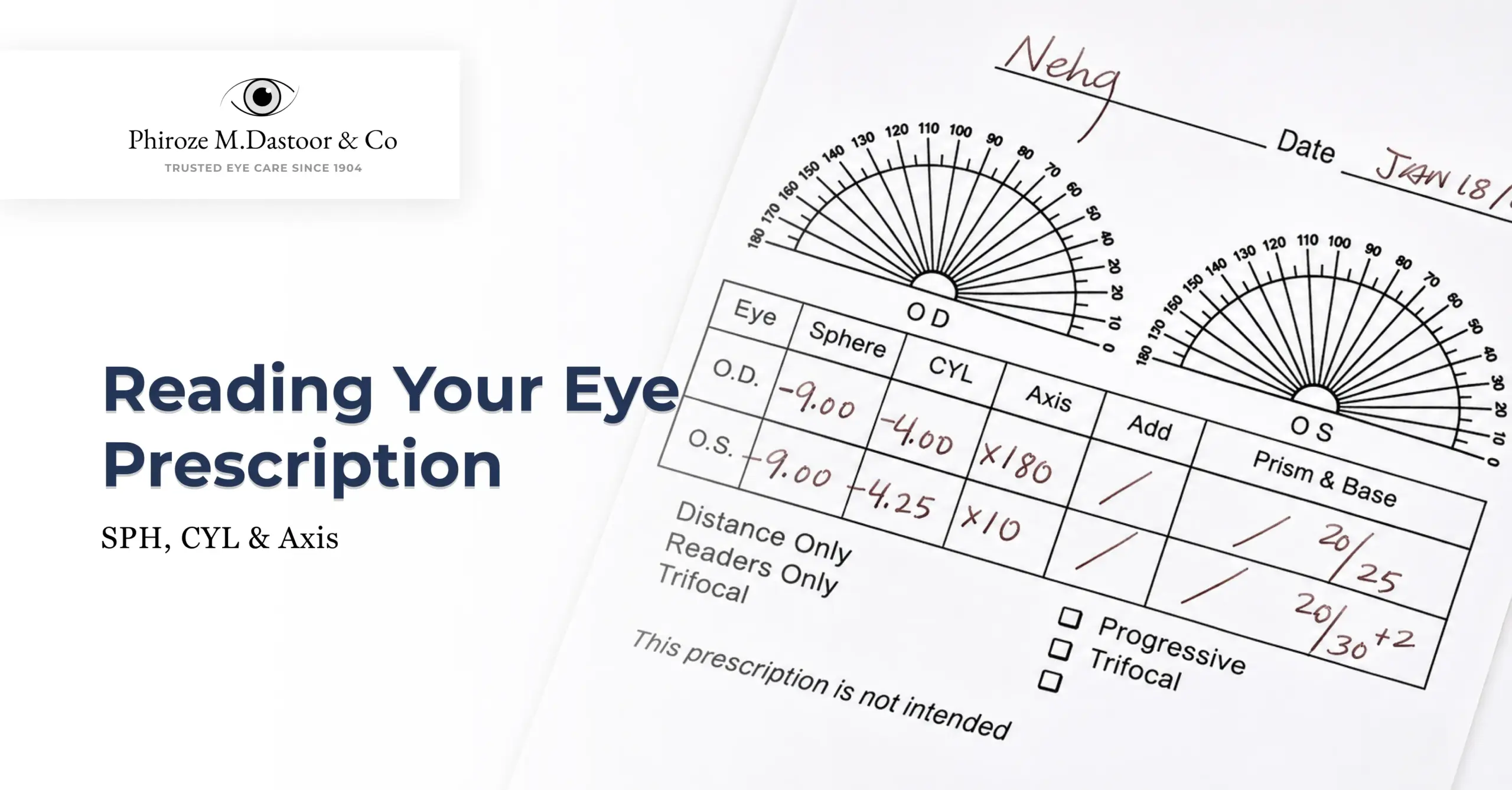
There is one line for each eye. OD means the right eye. OS means the left eye. Sometimes you will also see OU. It means both eyes. SPH is the main one. CYL and axis are the extra ones for astigmatism. ADD is for reading. If the readings are wrong then the lens will not work properly.
How to Read an Eye Prescription
The table given below will help you to understand the short words on your prescription-
| Full form | What it means | |
| OD | Oculus dexter | Right eye |
| OS | Oculus sinister | Left eye |
| SPH | Sphere | Main lens power for nearsightedness or farsightedness |
| CYL | Cylinder | Lens power for astigmatism |
| ADD | Addition | Extra power for reading in presbyopia |
| Axis | Axis | Direction of the astigmatism from 1 to 180 degrees |
SPH in Eye Test
SPH is the short form for sphere. It is a type of eye power measured during the eye test. It shows the main lens power needed to correct nearsightedness or farsightedness.
A minus sign means you are nearsighted. Near things look clear and distant things look blurry. This is called myopia. A plus sign means you are farsighted. Near things look blurry and sometimes distant things also. This is called hypermetropia or hyperopia. The bigger the number the stronger the lens. So -4.00 is stronger than -1.00. If you see a plano, it means no power is needed in that eye.
Eye Power Chart- What Does Your Eye Power Number Mean?
People often search for an eye power chart to see if their number is high or low. Following is a simple guide for the SPH number in nearsightedness.
| SPH Number | What it usually means |
| 0 to -3.00 | Mild myopia |
| -3.00 to -6.00 | Moderate myopia |
| -6.00 and above | High myopia |
These limits are only a guide. Doctors may use slightly different limits. Experts define high myopia as -6.00 D or more (Flitcroft et al. 2019). Farsightedness works in the same way. A higher plus number means stronger farsightedness.
CYL in Eye Test
CYL is the short form for cylinder. It shows the extra lens power needed to correct astigmatism. Astigmatism occurs when the front of the eye is not perfectly round. A normal eye is like a cricket ball. An astigmatic eye is more like a rugby ball. Because of this the light does not focus at one point and things look blurry or stretched.
If there is no number in the CYL column you do not have astigmatism. You may also see DS in this column. It means you only need a sphere power (AOP). The CYL number may have a minus or a plus sign depending on the style of your doctor. A small CYL like 0.50 or 0.75 is common.
Axis in Eye Test
Axis is a number from 1 to 180. It is measured in degrees. It shows the direction in which the astigmatism lies. Think of it as the angle at which the rugby ball is lying.
The axis comes right after the CYL number. If there is a CYL value there must be an axis value as well. If there is no CYL there will be no axis. The axis tells the lab where to place the cylinder power in the lens. If the axis is wrong the lens will not give clear vision even if the other numbers are right. So never copy the axis from an old prescription. The axis can be a little different in the two eyes.
ADD in Eye Prescription
ADD is short for addition. It is the extra power needed for near work like reading and using a phone. It is needed in presbyopia. It’s an age related change in the eye in which the lens inside the eye becomes stiff. It starts around the age of 40.
ADD is always a plus number and it is usually the same for both eyes. It is usually between +0.75 and +3.00. It increases slowly over the years. ADD is used in bifocal lenses and progressive lenses or in separate reading glasses.
Does a Higher Number Mean Bad Eyes?
A higher number means that you need a stronger lens. Your eyes can still be healthy. But a very high minus power above -6.00 raises the chance of problems inside the eye like retinal detachment. A big review found that people with high myopia had about 12 times higher odds of retinal detachment (Haarman et al. 2020). So if your number is high get a dilated retina check up as your doctor advises.
How Often Should You Get an Eye Test?
Many doctors advise an eye test every 1 to 2 years. Children and teenagers need it more often because their numbers change as they grow. After 40 years of age get checked every year for ADD and for eye diseases. A glasses prescription is not the same as a contact lens prescription. So do not use it for the other.
When to Visit a Doctor
Get a fresh eye test if you have a headache or eye strain or if you keep squinting. Also go if you hold your phone far away to read or cannot see the board or the road clearly at night. Go to the hospital at once if you have a sudden loss of vision or see flashes of light or many new floaters or have a dark curtain over your vision.
Understanding Your Eye Test & Prescription at Phiroze M Dastoor & Co
The ophthalmology team at Phiroze M Dastoor & Co can do a complete eye test and explain every number on your prescription. We also check the health of your eyes and tell you whether you need single vision lenses or progressive lenses or contact lenses.
If you have not got your eyes checked for a long time you can visit your nearest Phiroze M Dastoor & Co and get a complete eye test done at the right time.
Not sure what your prescription means?
Frequently Asked Questions
What is SPH in eye test?
SPH means sphere. It is the main lens power. A minus sign means nearsightedness and a plus sign means farsightedness.
What is CYL in eye test?
CYL means cylinder. It is the lens power for astigmatism. If it is blank you do not have astigmatism.
What is axis in eye test?
Axis is a number from 1 to 180 degrees. It shows the direction of the astigmatism. It is always written with the CYL number.
What does ADD mean in an eye prescription?
ADD is the extra reading power. It is needed after the age of 40 for presbyopia. It is always a plus number.
What is an eye power chart?
It is a guide that tells whether your number is mild or moderate or high. For nearsightedness up to -3.00 is mild and -3.00 to -6.00 is moderate. Above -6.00 is high.
What is a normal eye power?
A person who sees clearly without glasses has zero or almost zero power. Very small numbers like 0.25 or 0.50 may not need glasses. Your doctor will decide.
Is -2.00 a high power?
No. It is a mild power. Most people can see well with glasses of this power.
Why are the numbers different for the right and the left eye?
The two eyes are not exactly the same. A small difference is common.
Can I use my old prescription to buy new glasses?
No. Your numbers may have changed. Always get a fresh eye test. A contact lens prescription is also different from a glasses prescription.
How do I know if I need ADD?
If you are above 40 and find it hard to read small print or hold your phone far away you may need ADD. Your doctor will check it in the eye test.
References
Association of Optometrists (AOP). Your prescription explained.
Haarman AEG, Enthoven CA, Tideman JWL, Tedja MS, Verhoeven VJM, Klaver CCW. (2020). The complications of myopia: A review and meta-analysis. Investigative Ophthalmology and Visual Science,
Sheeladevi S, Seelam B, Nukella PB, Borah RR, Ali R, Keay L. (2019). Prevalence of refractive errors, uncorrected refractive error, and presbyopia in adults in India: A systematic review. Indian Journal of Ophthalmology,
Flitcroft DI, He M, Jonas JB, et al. (2019). IMI – Defining and classifying myopia: A proposed set of standards for clinical and epidemiologic studies. Investigative Ophthalmology and Visual Science,