In India, we often visit doctors only when there’s pain or visible discomfort, but when was the last time you had an eye test? Our eyes silently adapt to small changes until it’s too late. Regular eye tests aren’t just about getting new glasses; they can detect early warning signs of diabetes, blood pressure problems, and even neurological issues early. With just one visit, you could prevent vision loss and protect your overall health.
All content is reviewed by our medical team to ensure reliability but you should always consult a practitioner if you have any eye concerns or vision symptoms.
Common Eye Evaluations You Should Know About
Eye tests are quick, painless, and give valuable insights into your eye health. Here are some of the most common evaluations:
- Visual acuity checks- It is a test of reading letters of different sizes on a chart to measure how clearly you can see. It measures how sharp your vision is at a far distance. Different test types can look at different aspects of vision capacity.
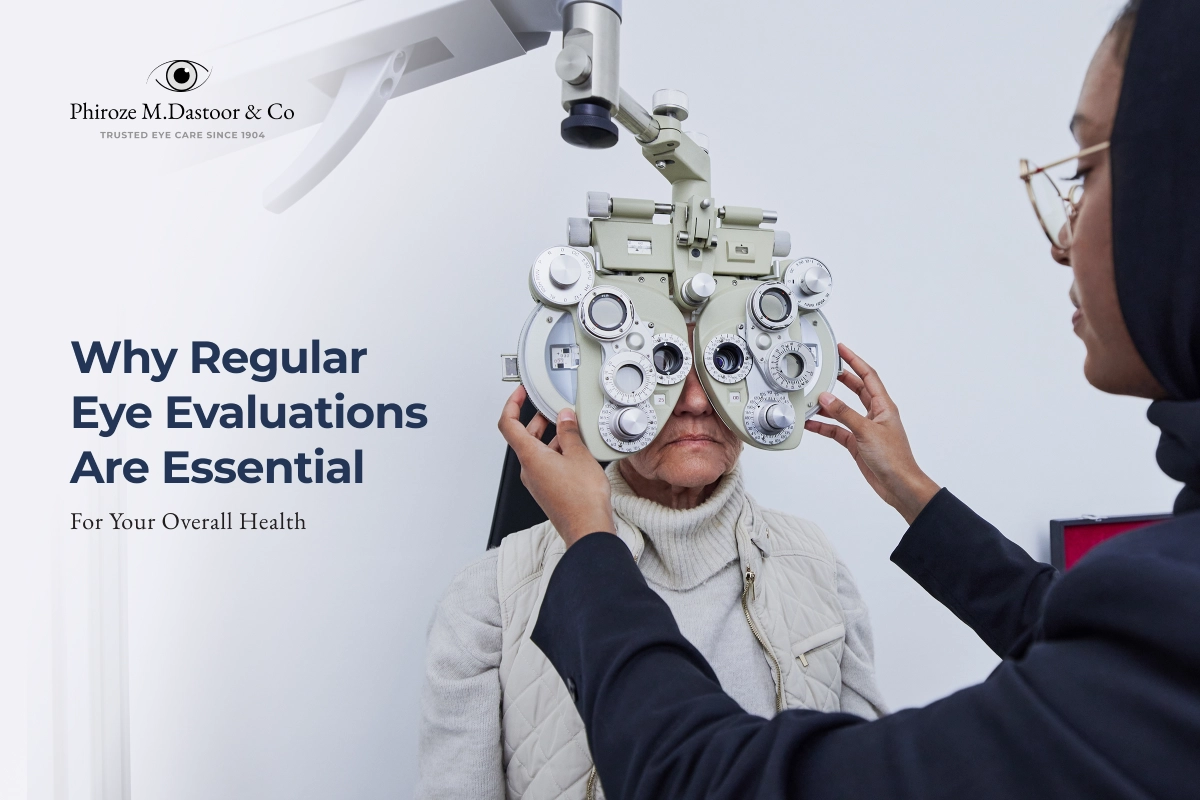
- Refraction (prescription) evaluation- An Optometrist places different lenses in front of your eyes (using a phoropter or trial frames). Objective and subjective measurements help determine the best prescription for your eye measurements and lifestyle needs eg taking in to account your vision routine, working distances and lifestyle.
- Intraocular pressure evaluation- This measures the pressure inside your eyes. High pressure can be a sign of glaucoma, which damages the optic nerve if left untreated.
- Pupil dilation evaluation- The doctor uses special eye drops to widen your pupils and get a better view of the retina, optic nerve, and other internal structures.
- Retinal examination – After dilation, the back of your eye is examined for signs of damage or conditions like diabetic retinopathy (a condition wherein the retina of the eyes is damaged because of high blood sugar levels), eye damage because of high blood pressure, macular degeneration, and other diseases.
- Visual field evaluation- This test maps your entire field of vision and can identify vision loss areas, often linked to retinal, optic nerve or brain conditions. This can screen for vision changes that may not be symptomatic yet.
- Cover evaluation- In this test, one eye is covered while you focus on an object. If the eyes are not properly aligned and one eye drifts when the other is covered, it may indicate strabismus, a condition where the eyes do not point in the same direction, or developing muscle weaknesses.
These eye evaluations are essential to reveal different eye conditions or diseases, which should be caught early to prevent future eye damage or vision loss.
What Eye Examinations Can Reveal
Regular eye examinations do more than just check your vision; they help identify various conditions that affect your eyesight, eye health, and overall wellbeing.
Refractive Errors:
- Nearsightedness (myopia): Difficulty seeing distant objects clearly.
- Farsightedness (hyperopia): Difficulty seeing nearby objects clearly.
- Astigmatism: Difficulty seeing clearly at any distance (whether far or near). This is because the shape of the eye (often on the cornea or within the lens) is irregular – described as being rugby ball shaped rather than round or football shaped.
- Presbyopia: Difficulty with focusing on near tasks. It is mainly age-related because the lens has become stiff and less flexible – usually thought of as the need for “reading glasses”.
- Dry Eye Syndrome: A condition in which the eyes either do not produce enough tears or the tears evaporate too quickly. Common symptoms include a burning sensation or a gritty feeling in the eyes. Factors such as prolonged screen time, dry environments, contact lens use, ageing, or certain medications can contribute to this condition. Understanding the underlying cause is important for identifying suitable ways to manage and relieve the symptoms.
- Binocular vision dysfunction: A condition wherein there is poor coordination of the eyes, and therefore, the eyes cannot focus on a particular object. It is commonly seen in people with lazy eyes or crossed eyes.
- Floaters: Small, shadowy spots or thread-like shapes that move across your vision. They appear when tiny particles form inside the clear gel of the eye. Most are harmless, but a sudden increase in floaters can sometimes be an early sign of a more serious eye problem.
There are also serious eye diseases that can be detected early through routine checkups. Identifying and managing these conditions in time helps prevent further damage and vision loss.
9 Serious Eye Diseases Detected Through Eye Exams
Regular eye exams don’t just check your vision, they can reveal underlying eye diseases that often show no early symptoms. Here are some important ones to know about:
- Cataracts: Cloudiness occurs in the lens of the eye, resulting in unclear, hazy vision, almost like looking through fogged glasses.
- Glaucoma: It is caused by high eye pressure, particularly pressure on the optic nerve, over time, leading to damage to the optic nerve. The condition is also known as ‘Silent thief of sight’ as a person is not able to recognise the disease because there is no noticeable symptom until permanent vision loss occurs. If left untreated, glaucoma can lead to irreversible blindness. There are also types of glaucoma where the pressure is normal, hence the importance of routine screening.
- Macular Degeneration: An age-related condition that affects the macula, the part of the retina responsible for sharp central vision. It makes it difficult to focus on objects directly in front of you or to read clearly.
- Retinal Tears: A condition wherein a tear occurs on the retina. Signs like sudden flashes of light, a shadow of floaters, a shadow/curtain-like effect over the part of vision.
- Hypertensive retinopathy: High blood pressure can cause narrowing or bleeding of the eye’s blood vessels. It occurs due to hypertension, also known as high blood pressure, hence the name.
- Diabetic retinopathy: High or uncontrolled fluctuating blood sugar levels can lead to vessel changes, bleeds and vision loss.
- High Cholesterol: High cholesterol levels sometimes manifest as yellowish deposits on the eyelids or as a gray-white ring around the cornea.
- Cancers: Eye exams can help detect cancers that start in the eye or spread to the eye from other parts of the body. Early detection allows timely treatment and better management of the condition.
- Autoimmune Diseases: Conditions like lupus or rheumatoid arthritis can cause eye inflammation and, therefore, a burning sensation, and redness of the eye can occur. Changes in the eye can also be the first sign towards autoimmune disease.
Government Initiatives for Affordable Eye Care
Eye health is not only a personal responsibility, but it is also a public health priority. Thankfully, several government programmes and charitable organisations in India are working to make quality eye care accessible and affordable for everyone. These initiatives ensure that even the most vulnerable groups have access to essential eye care.
Separating Fact from Myths
When a 45-year-old female visited her eye clinic expecting a routine prescription for new reading glasses, she found out that she had early signs of diabetes.
This story is not unusual. An eye examination can detect more than 270 diseases, often years before symptoms emerge elsewhere. Yet many people avoid eye tests because of common myths. Let’s clear them up:
- Myth: “If I can see clearly, my eyes are healthy.”
Fact: Conditions like glaucoma cause no early symptoms, and therefore, a person might not be able to know if they have glaucoma, but it can lead to irreversible blindness if ignored.
- Myth: “Eye tests only check if I need glasses.”
Fact: A thorough examination can reveal signs of diabetes, hypertension, heart disease and even certain cancers.
- Myth: “Traditional remedies are always safe.”
Fact: Some may help, but unsafe practices like homemade kohl or applying honey can cause infections. Always seek professional advice.
- Myth: “Children don’t need eye tests unless they complain.”
Fact: Children often adapt to poor vision without realising it. Up to one in four school-age children has an undiagnosed vision problem affecting learning.
The Hidden Cost of Neglect
Over 90% of vision impairment is preventable or treatable if caught early.
When Should You Get an Eye Evaluation?
Children:
- First test: Newborn (right after birth)
- Second test: 6–12 months
- Third test: 12–36 months
- Fourth test: 3–5 years
- Regular tests: Every year from age 5 and older
For adults with no symptoms or low risk:
- Ages 18 to 39: Every 2 years
- Ages 40 to 64: Every 2 years
- Age 65 and older: Annually
For adults at higher risk:
- Ages 18 to 39: Annually or as recommended
- Ages 40 to 64: Annually or as recommended
- Age 65 and older: At least annually
Even after LASIK or PRK surgery, the AOA recommends an eye exam every 1-2 years to monitor overall eye health.
Taking Action Today
By now, you understand that eye tests are about more than just getting glasses. They help protect your vision and your overall health. Your eyes have a story to tell. The real question is, will you listen before it is too late?
Do not let myths, costs, or convenience stop you. Prioritising your eye health today is an investment in your future, your family, and your quality of life. Book your comprehensive eye examination with the Phiroze Dastoor in team Mumbai, because healthy eyes mean a healthier life.
References:
- American Optometric Association. (n.d.). Full picture of eye health. Retrieved September 30, 2025, from https://www.aoa.org/healthy-eyes/caring-for-your-eyes/full-picture-of-eye-health
- Gudgel, D. (2024, July 10). Eye screening for children. American Academy of Ophthalmology. Reviewed by M. X. Repka, MD, MBA, and edited by D. Porter. Retrieved from https://www.aao.org/eye-health/tips-prevention/eye-screening-children
- Stern, J., Yasmin, S., Qureshi, M. B., & others. (2024). 2030 In sight: The future of global eye health. Eye, 38(10), 1979–1980. https://doi.org/10.1038/s41433-023-02815-2
Frequently Asked Questions (FAQs)
Even if your vision feels fine, checkups matter. Children: first at 6-12 months, then at 2-5 years, and annually from age 6. Adults: every 2-3 years until 40, then every 2 years until 65, and yearly after that. If you have conditions like diabetes or high blood pressure, yearly exams are a must.
Absolutely. Your eyes can reveal early signs of diabetes, high blood pressure, heart issues, and even autoimmune conditions, often before you notice any symptoms.
Yes. Some conditions, like glaucoma, can develop silently. Regular eye tests make sure nothing is quietly harming your vision.
Glasses-related problems like nearsightedness or astigmatism, dry eyes, crossed eyes, floaters, cataracts, glaucoma, macular degeneration, and diabetic eye changes. Catching them early makes all the difference.
Long hours on screens can cause dryness, strain, and headaches. Regular eye examinations help you understand the impact and give tips to keep your eyes comfortable and healthy.