Summary
Blue light glasses filter selected wavelengths of visible blue light and are commonly considered for screen-heavy routines. Their usefulness depends on the type of filter, prescription and individual visual needs. They are best looked at as one part of the complete spectacle lens, alongside comfort, glare control, working distance and everyday screen habits.
Blue light glasses are now a common option when choosing spectacle lenses, especially if screens make up a large part of your day. They are usually chosen for blue-light filtration and screen comfort, but the lens itself is only one part of the picture.
Your prescription, working distance, lighting and the way you use screens can all affect comfort. So before deciding whether a blue cut lens is right for you, it helps to understand what it actually filters.
Blue Light Glasses and How a Blue Cut Lens Works
Blue light is part of the visible-light spectrum. It occurs naturally in daylight and is also produced by LED lighting and digital devices such as phones, tablets and computer screens.
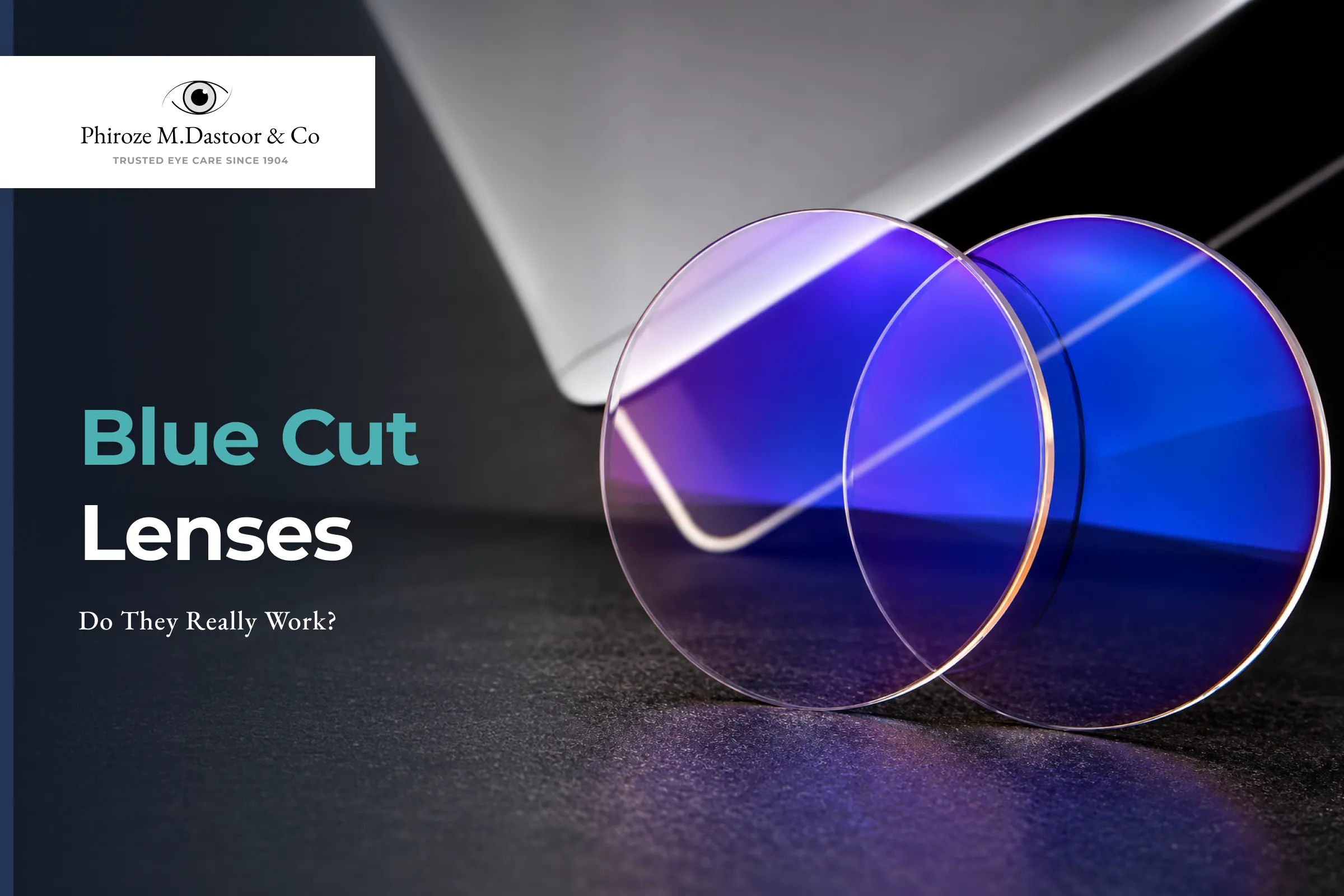
A blue cut lens is designed to reduce the amount of selected blue wavelengths passing through the spectacle lens. Depending on the product, this may be achieved through the lens material itself, a coating on the surface or a tint.
Not all blue-light filters are the same. Some look almost completely clear, while others have a slight yellow or amber tint. Two pairs described as blue light glasses can therefore filter light differently.
When choosing spectacle lenses, blue-light filtration is usually considered alongside the prescription, lens design, anti-reflective properties, thickness and fit of the frame.
What can vary between blue cut lenses?
- The amount of blue light filtered
- The part of the blue-light spectrum targeted
- Whether the lens looks clear or slightly tinted
- Whether anti-reflective properties are included
- Whether the lens also contains a prescription
- How the lens feels during different visual tasks
The filter does its job, but screen comfort depends on more than blue light alone.
Where Blue Light Glasses Fit Into Your Routine
If you spend much of the day moving between a laptop, phone and other close work, blue-light filtration may be one feature to consider in your everyday glasses.
But comfort also depends on whether your prescription is current, how far you sit from the screen, glare and how long you stay focused at one distance.
Your glasses may also need to work across screens, meetings, driving, outdoor use and general day-to-day vision.
The whole lens should therefore suit your routine rather than one device or one feature.
Why Screens Can Leave the Eyes Feeling Tired
Long periods of screen use can sometimes be associated with tired eyes, dryness, temporary blur or difficulty keeping things comfortably in focus.
Several things can contribute at the same time.
Common factors include:
- reduced or incomplete blinking during concentrated screen work
- long periods of close or intermediate focus
- glare or reflections from windows and lighting
- a screen that is much brighter than the surrounding room
- an uncomfortable viewing distance or screen position
- spectacles that no longer suit your current visual needs
Blinking is particularly relevant. You may blink less when concentrating on a digital task, and blinking helps spread the tear film across the surface of the eye. Long periods at a screen can therefore contribute to dry eye symptoms.
The focusing demand matters as well. Reading from a phone or working on a computer means holding the eyes at a relatively fixed distance for long stretches of time.
Lighting can add another layer. Reflections, overhead glare or a bright screen in a dark room may make visual work less comfortable than it needs to be.
These factors help explain why screen comfort is not determined by blue light alone.
Blue Cut Lenses and Everyday Eye Protection
Digital devices are often associated with blue light, but daylight is a much larger source in everyday life.
A blue cut lens filters selected wavelengths; it is not a medical shield against screen damage.
Current human evidence has not established normal phone, tablet or computer use as a cause of retinal damage from blue light. Screen discomfort and retinal damage are two different things.
You can still experience dryness, fatigue or difficulty focusing after long screen sessions. Those symptoms are better considered alongside blinking, focus, glare, lighting and prescription.
Blue light does, however, affect the body’s sleep-wake cycle, which is why these lenses are also discussed in relation to evening use.
Blue Light Glasses and Sleep
Light helps regulate your circadian rhythm, the internal system involved in sleep and wakefulness. Blue wavelengths are particularly active in this signalling, especially later in the day.
That is why blue-light glasses are sometimes considered for evening screen use.
The type of filter matters too. A near-clear lens designed for everyday wear is different from a stronger amber or orange filter, and sleep studies have often used the stronger type.
The wider evening environment matters too:
- how bright the screen is
- how close to bedtime it is being used
- the lighting in the room
- the length of screen exposure
- the strength of the blue-light filter
If sleep is the concern, think of the lens as one part of your evening routine rather than the whole answer.
Blue Cut Glasses Benefits: What Should You Look For?
Blue-cut lenses can offer different features depending on how they are made. When comparing options, it helps to separate the filtering function from the other parts of the lens.
| Feature | What it means in everyday use |
| Filters selected blue wavelengths | This is the basic optical function of a blue cut lens |
| Can be used in everyday spectacles | Blue-light filtration can be incorporated into regular prescription or zero-power lenses |
| Different filter strengths are available | Near-clear and more strongly tinted lenses may filter different amounts of blue light |
| Can be combined with anti-reflective properties | Some lenses include both blue-light filtration and reflection control |
| Can be combined with prescription correction | The filtering feature can form part of the same lens used for vision correction |
| Comfort can vary between wearers | Prescription, fit, working distance, glare and visual routine all influence the overall experience |
It is also worth asking whether the complete lens suits the work, distances and environments you use it for.
What matters when choosing a blue cut lens?
- your current prescription
- how many hours you spend on digital devices
- whether most of your work is near or intermediate distance
- glare and lighting in your usual environment
- whether you prefer a near-clear or more noticeable tint
- anti-reflective properties
- the overall design and fit of the spectacles
The right combination depends on how you use your glasses day to day.
Making Screen Time More Comfortable
Lens choice matters, but a few simple habits can make prolonged screen use easier too.
Take Regular Breaks From Close Focus
The 20-20-20 rule is an easy reminder: after roughly 20 minutes of close work, look at something around 20 feet away for about 20 seconds. The useful part is not following a timer perfectly, but remembering to change focus regularly.
Blink Normally
Concentration can reduce how often you blink, particularly during reading or detailed computer work.
Keep the Screen at a Comfortable Distance
For a desktop setup, around an arm’s length can be a useful starting point.
Keep the Screen Slightly Below Eye Level
A monitor placed too high can make a long working session less comfortable.
Reduce Unnecessary Glare
Reflections from windows, bright lights or glossy surfaces can make prolonged screen use less comfortable.
Balance Screen and Room Brightness
A very bright monitor in a dark room may feel less comfortable than a screen that is better matched to the surrounding lighting.
Check Whether Your Prescription Still Suits the Task
Visual requirements can change over time, and the same correction may not always feel ideal for every working distance.
If these changes do not settle the problem, a personalised eye examination can help check whether your prescription, focusing or another visual factor may be contributing.
When Should You Consider an Eye Assessment?
Screen discomfort does not always mean you need new spectacles. But if the same symptoms keep returning, it is worth understanding what may be contributing.
An assessment may be useful if you regularly notice:
- blurred vision during reading or screen work
- headaches linked to prolonged close work
- ongoing dryness or irritation
- difficulty keeping near work in focus
- trouble moving comfortably between near and distance vision
- increasing visual fatigue during the working day
An eye examination can look beyond the lens coating and assess your prescription, focusing needs, how your eyes work together and the surface of the eye.
Choosing the Right Blue Cut Lens for You
If you spend a large part of your day on screens, blue-light filtration can be one feature to consider. What matters just as much is whether the complete lens suits your prescription, usual working distance, lighting and how you use your glasses throughout the day.
Rather than choosing a lens for one feature alone, look at the whole design: filtration, anti-reflective properties, tint, lens material and fit. Each feature should have a reason to be there.
Not sure which lens suits your screen routine?
Book a personalised eye examination at Phiroze M. Dastoor & Co. to have your vision assessed and discuss lens options that fit your everyday needs.
Frequently Asked Questions
Do blue light glasses really work?
Blue light glasses do filter selected blue wavelengths, but current evidence has not shown a clear benefit for short-term eye strain or visual comfort. Whether you notice a difference depends on the lens and why you are wearing it, so they are best considered as one part of the overall spectacle choice.
What is the difference between a blue cut lens and a normal lens?
A blue cut lens filters selected blue wavelengths, while a standard spectacle lens may not include this feature. Both can still contain prescription correction, anti-reflective coatings and other lens features.
Do blue light glasses help with eye strain from computers?
They can be part of a screen-friendly lens setup, but blue-light filtration is only one factor. Your prescription, viewing distance, glare, lighting, blinking and breaks from close focus can all affect how your eyes feel during computer work.
Can blue light glasses be worn all day?
Yes. Many near-clear blue-light filtering lenses are designed for everyday wear. Stronger yellow or amber filters can alter colour perception more noticeably, so the best option depends on the lens and how you plan to use it.
Are blue cut lenses and anti-glare lenses the same?
No. A blue cut lens filters selected blue wavelengths, while an anti-glare or anti-reflective coating reduces reflections from the surfaces of the lens. Some modern spectacle lenses combine both features. [PLACEHOLDER LINK: link “anti-reflective coating” to the Types of Lenses for Glasses blog once published]
Do blue light glasses help with sleep?
They may influence evening light exposure, but the effect varies with the strength of the filter and when it is worn. Near-clear everyday lenses also differ from the stronger amber filters used in some sleep research.
Can you get blue light glasses without prescription power?
Yes. Blue-light filtering lenses are available in both prescription and zero-power glasses. A zero-power lens can provide the filtering feature but does not correct short-sightedness, long-sightedness, astigmatism or other refractive errors.
References
Abass, R., Fathy, A. and Abass, A. (2026) ‘Blue-Light Filters in Eye Care: A State-of-the-Art Review’, Medical Sciences, 14(5), 530.
American Academy of Ophthalmology (2021) ‘Are Blue Light-Blocking Glasses Worth It?’ (Accessed: 7 October 2026).
Luna-Rangel, F.A. et al. (2025) ‘Efficacy of blue-light blocking glasses on actigraphic sleep outcomes: a systematic review and meta-analysis of randomized controlled crossover trials’, Frontiers in Neurology, 16, 1699303.
Pucker, A.D. et al. (2024) ‘Digital Eye Strain: Updated Perspectives’, Clinical Optometry, 16, pp. 233–246.
Singh, S. et al. (2023) ‘Blue-light filtering spectacle lenses for visual performance, sleep, and macular health in adults’, Cochrane Database of Systematic Reviews, 2023(8), CD013244.