Summary
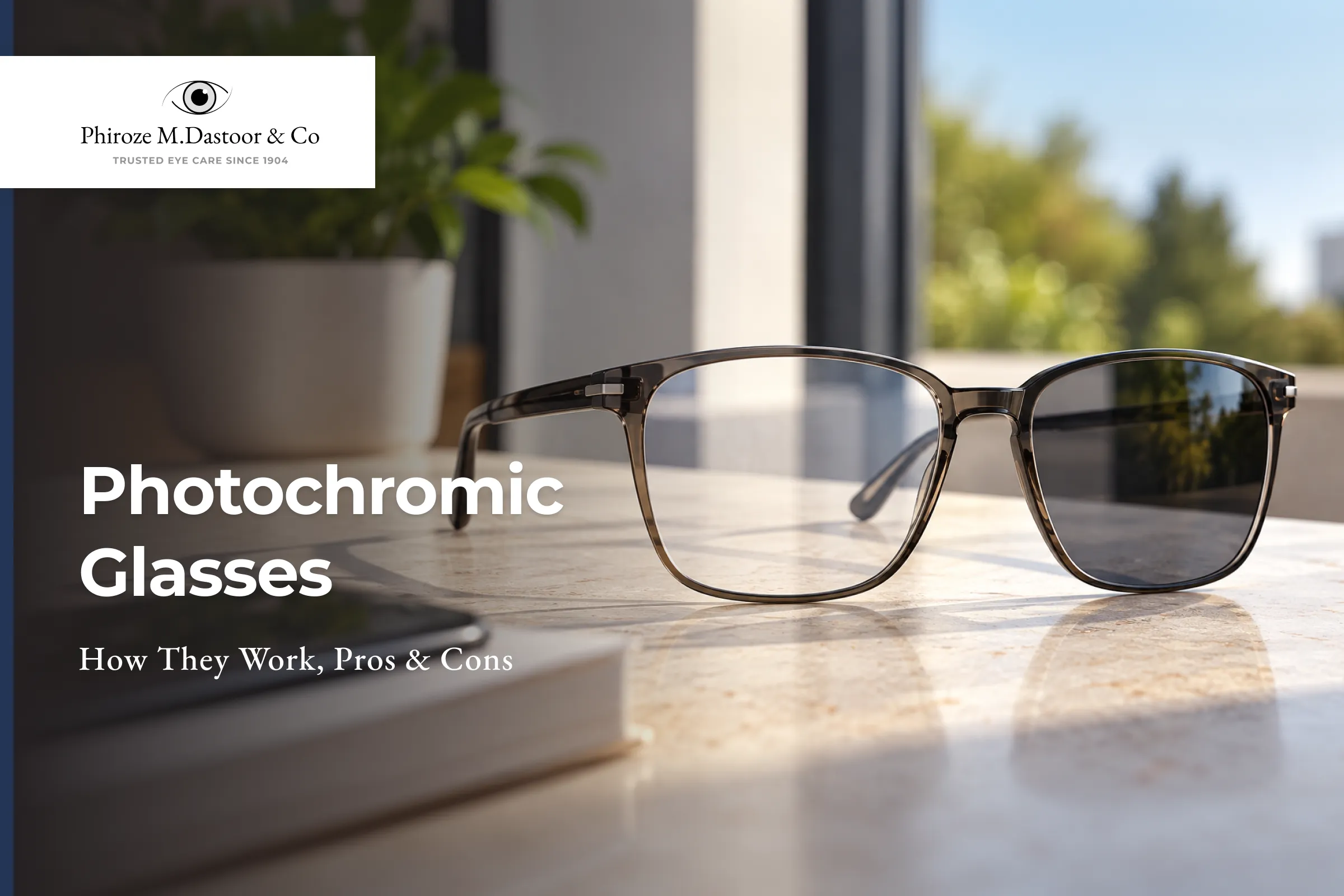
Photochromic glasses have lenses that darken outdoors and return to clear, or nearly clear, indoors. If you regularly move between indoor and outdoor spaces, they can reduce the need to keep changing glasses. However, they usually darken less inside a car, and their response can vary with temperature and lens type.
You step out of a shop into bright afternoon sunlight and, after a short while, your clear lenses begin to develop a tint. When you go back indoors, they gradually become clear again.
If your glasses do this, you are wearing photochromic glasses. You may also hear them described as light-adaptive lenses.
The idea sounds simple, but you may notice that the lenses do not behave exactly the same way everywhere. They may look darker on one day than another, respond differently inside your car or take a little time to clear after you walk indoors.
Understanding why this happens can help you decide whether a photochromic lens fits the way you actually use your glasses.
What are photochromic glasses?
Photochromic glasses are spectacles fitted with lenses that remain clear, or nearly clear, indoors and develop a tint when you go outside.
You can have photochromic lenses with many spectacle prescriptions, including single vision, bifocal and progressive designs. Different tint colours may also be available depending on the product.
If you are considering them, one point is worth understanding from the beginning. The lenses do not simply react because your surroundings look bright. Their response is mainly triggered by ultraviolet light.
That explains much of what you will notice when wearing them.
How photochromic lenses work
A photochromic lens contains light-sensitive compounds that change their structure when ultraviolet light reaches them.
When the lens is in its clearer state, more visible light passes through. Once UV activates the photochromic compounds, they begin to absorb more visible light and the lens becomes darker.
When you move indoors and UV exposure drops, those compounds gradually return to their original state. The lens then becomes clear again.
So when you walk from an office into bright daylight, you do not need to press a button or manually adjust anything. The change happens within the lens itself.
Temperature can influence this reaction too, which is why you may sometimes notice that the same pair of glasses behaves slightly differently from one day to another.
How photochromic lenses respond to different light conditions
Outdoors during the day, there is usually enough UV to activate photochromic lenses.
Once you go indoors, UV exposure falls considerably, and the lenses begin returning towards clear.
A cloudy day does not necessarily stop the process. UV can still be present even when the sky looks grey, so your lenses may develop some tint despite the lack of strong sunshine.
You may therefore notice them changing on days when you did not expect them to.
There is one situation where the response can be noticeably different: sitting inside your car.
Do photochromic lenses work inside a car?
Usually, but not as strongly as they do when you are standing outdoors.
Most windscreens filter much of the UV that normally activates photochromic lenses. Because less triggering light reaches your glasses, they may remain considerably lighter while you are driving.
Side windows can behave differently, and the amount of UV entering a vehicle can vary.
Some newer photochromic lens technologies also respond partly to visible light. These may develop more tint behind a windscreen, although the degree of change still depends on the individual lens.
If you spend a large part of your day driving, this is worth asking about before you choose your lenses. You may still prefer to keep a separate pair of sunglasses for brighter journeys.
Weather can make another noticeable difference.
How does temperature affect photochromic lenses?
You may find that your glasses look or behave slightly differently depending on the temperature.
In cooler conditions, some photochromic lenses can become darker and may take longer to return to clear. In warmer weather, the tint may remain lighter and may fade sooner.
So if you wear the same glasses on a hot afternoon in Mumbai and later on a much cooler trip, you may notice a difference in how dark they become.
The transition is not immediate either.
When you step outdoors, the tint develops gradually. When you return indoors, your lenses may remain slightly tinted for several minutes before they settle back towards clear.
How quickly that happens depends on the particular lens technology, temperature and surrounding light.
That automatic response is one of the main reasons people consider photochromic glasses, but it also creates some of their limitations.
Advantages and disadvantages of photochromic glasses
Photochromic lenses can make everyday spectacle use more convenient, but they may not be suitable for every situation.
Below are the main advantages and limitations to consider before deciding whether they suit your routine.
| Advantages | Limitations |
| If you regularly move between indoors and outdoors, you may not need to keep changing between clear spectacles and sunglasses. | Your lenses may remain tinted for a short while after you come indoors. |
| The lenses respond to changing light conditions without you having to change or attach anything. | Windscreens filter much of the UV that activates standard photochromic lenses. |
| Many photochromic lenses are available with UV protection, although you should check the individual lens specification. | Temperature, light conditions and the specific lens technology can affect how dark they become. |
| Photochromic lenses are available across several common spectacle lens designs. | If reflected glare is important to you, check whether the lens also has polarisation. |
| They can be useful if your day involves frequent movement between indoor and outdoor spaces. | The lenses respond automatically, even when you might prefer them to remain clear. |
Photochromic lenses are therefore one spectacle-lens option rather than an automatic upgrade for everyone. You can also explore PMD’s spectacle lens options to see how photochromic lenses sit alongside other lens types.
One of the advantages above deserves a little more explanation because tint and UV protection are often assumed to mean the same thing.
UV protection and photochromic lenses
Many photochromic lenses provide UV protection, but you should confirm this from the specification of the particular lens you are choosing.
A dark-looking lens does not automatically tell you how much ultraviolet radiation it filters.
When comparing lenses, check what level of UV protection the manufacturer states. You may also see specifications such as UV400 on some products.
Your frame matters too. If you wear a smaller everyday spectacle frame, some sunlight can still reach your eyes around the sides. Larger sunglasses may provide more physical coverage.
Photochromic lenses can therefore combine everyday light adaptation with UV protection when appropriately specified, but they are not a treatment for an eye condition.
If you are deciding between these lenses and ordinary sunglasses, the difference becomes clearer when you compare how each behaves in everyday situations.
Photochromic glasses vs regular sunglasses
Below is a comparison of the two options:
| Feature | Photochromic glasses | Regular sunglasses |
| Tint | Changes in response to light and UV | Fixed tint |
| Indoors | Clear or nearly clear | Remain tinted |
| In a car | Usually lighter than outdoors | Fixed tint |
| UV filtering | Check the lens specification | Check the lens specification |
| Reflected glare | Not polarised unless specified | Polarised options widely available |
| Coverage | Usually everyday spectacle-frame size | Larger and wraparound styles available |
If most of your day involves moving between offices, shops, transport and outdoor spaces, the automatic change may be convenient.
If you spend several hours driving, sitting in strong sunlight or near reflective surfaces such as water, you may prefer a dedicated pair of sunglasses.
You may also find that owning both works better than trying to make one pair do everything. If driving, outdoor activities or changing light conditions are a major part of your day, you can also explore PMD’s lifestyle eyewear options.
Who may find photochromic glasses useful?
Think about how often your surroundings change during an ordinary day.
If you leave home, commute, walk between buildings, step out for lunch, run errands and return indoors several times, repeatedly changing between prescription glasses and sunglasses can become inconvenient.
Photochromic lenses may make that routine simpler because the tint adjusts without you changing spectacles.
On the other hand, if much of your outdoor time involves long drives or several hours in strong sunlight, separate sunglasses may still suit you better.
Your decision does not need to be based on which lens sounds more advanced. It should come down to which one fits the way you actually use your glasses.
Choosing the right spectacle lenses
Before ordering photochromic lenses, picture a normal day rather than only thinking about how the lenses look in the optical store.
Consider:
- How much time do you spend driving?
- How often do you move between indoors and outdoors?
- Do you spend long periods in strong sunlight?
- Would it bother you if the lenses took a few minutes to become completely clear indoors?
- Do you prefer a particular tint colour?
- Is glare reduction important to you?
- Does the lens specification clearly state its UV protection?
Your prescription, lens design and frame choice matter as well. If you are comparing more than one lens feature, our guide to types of lenses for glasses explains how lens design, material and coatings differ. [PLACEHOLDER LINK: add live URL once the Types of Lenses for Glasses blog is published]
If you are already planning to buy new spectacles, an eye examination is also an opportunity to discuss how you use your glasses during work, driving and outdoor activities.
At Phiroze M. Dastoor, your spectacle options can be considered alongside your prescription and everyday visual needs so that the choice suits your routine rather than simply following a lens trend.
Considering photochromic lenses?
Speak with the team at Phiroze M. Dastoor & Co. about whether photochromic lenses suit your prescription and everyday visual needs.
FAQs
Do photochromic glasses work at night?
At night, there is very little UV to activate the lenses, so they generally remain in their clear state and work like ordinary spectacles. The photochromic tint itself is not designed to deal with glare from headlights. An anti-reflective coating is a separate lens feature.
Can photochromic lenses have an anti-reflective coating?
Yes. A photochromic lens can also have an anti-reflective coating. This coating reduces reflections from the surfaces of your lenses and is separate from both the tint-changing function and UV protection.
Can you get photochromic lenses with your prescription?
Yes. Photochromic lenses are available with many spectacle prescriptions, including single vision, bifocal and progressive lenses. The options available to you depend on your prescription, lens design and manufacturer.
Do photochromic lenses become completely clear indoors?
Most return to clear or very nearly clear indoors, although the change takes time. Some products may retain a faint tint after they have settled. If having a completely clear appearance indoors matters to you, ask to see how the particular lens looks in its clear state before choosing it.
References
American Academy of Ophthalmology (2024) Sunglasses With Transition Lenses: Pros and Cons.
American Academy of Ophthalmology (n.d.) Recommended Types of Sunglasses.
American Academy of Ophthalmology (n.d.) How to Pick the Best Sunglasses to Protect Your Eyes.
Boxer Wachler, B.S. (2016) ‘Assessment of levels of ultraviolet A light protection in automobile windshields and side windows’, JAMA Ophthalmology, 134(7), pp. 772–775.
College of Optometrists (2024) Driving and vision.
College of Optometrists (2022) Sun and ultraviolet (UV) light.
Moon, B.-Y., Kim, S.-Y. and Yu, D.-S. (2020) ‘Differences in the optical properties of photochromic lenses between cold and warm temperatures’, PLOS ONE, 15(5), e0234066.