Key Takeaways
|
Sunglasses are not just a fashion item in India. The sun here is strong for most of the year. In a study of about 9700 rural adults aged 40 years and above from different parts of India 13.2% had pterygium in at least one eye (ICMR-EYE SEE Study Group 2022).
This growth on the eye is linked to sun exposure. People get confused when they go to buy sunglasses. The shop says polarised. The tag says UV400. The price is very different. Many people think polarised means better UV protection. This is not true. Some people think polarised glasses are only for fishing. This is also not true.
In this blog we explain the polarized sunglasses meaning in simple words. We also cover polarized vs non polarized sunglasses and polarized vs UV protection. Then we talk about the benefits and the limits and which pair you should choose.
Not sure what your prescription means?
What Are Polarized Sunglasses? Meaning and How They Work
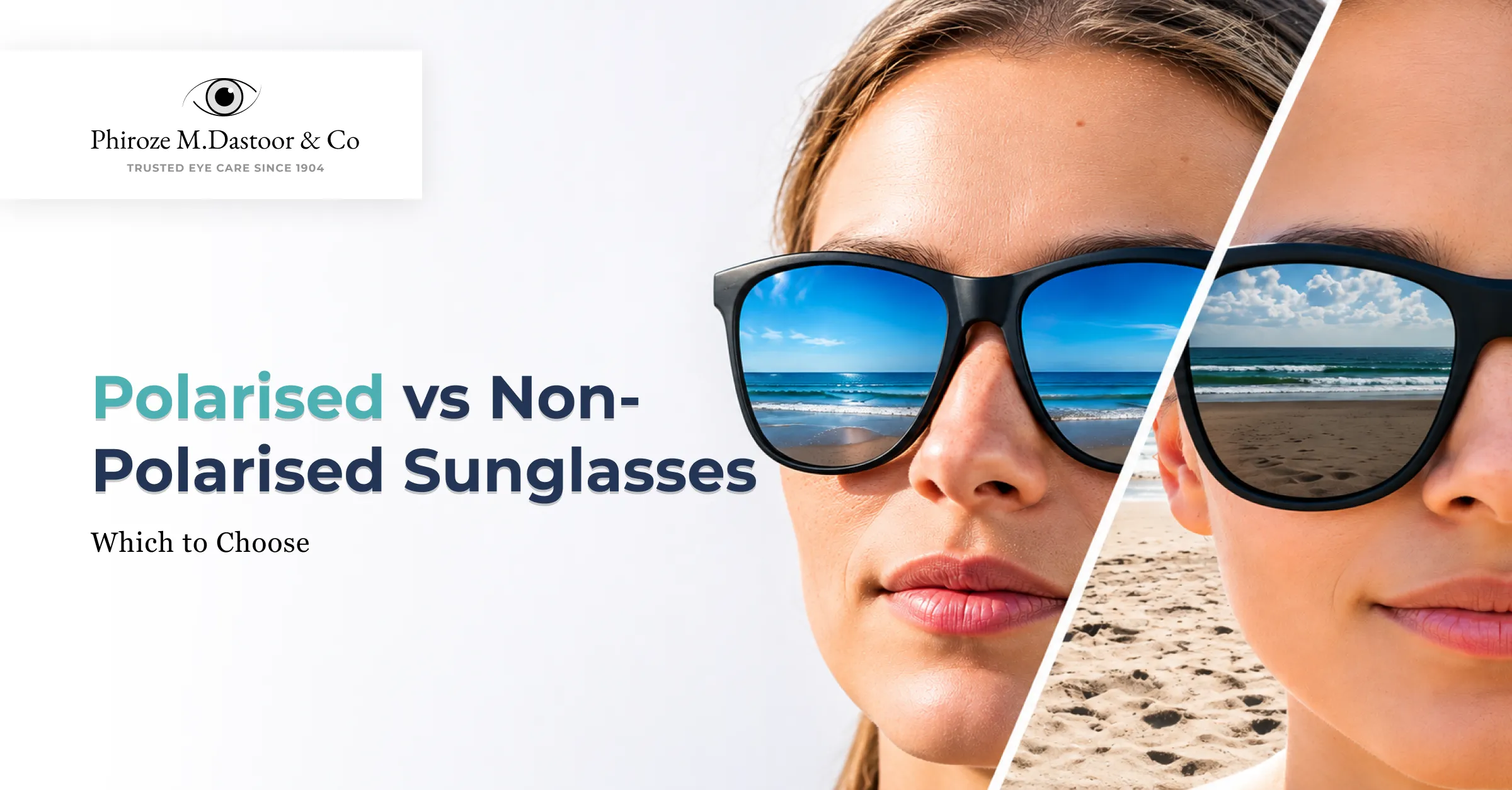
Polarised sunglasses have a special filter built into the lens. This filter cuts the glare that bounces off flat shiny surfaces. Examples are water and wet roads and car bonnets and snow.
To understand it more easily first think of the filter as tiny window blinds. Light that bounces off a flat surface mostly vibrates in a horizontal direction. This is the glare that hurts your eyes. The blinds in the lens let only vertical light pass through. So the glare is cut and the view looks clearer (AllAboutVision).
Non polarised sunglasses only have a tint. The tint makes everything darker. It reduces the brightness but it does not remove the reflected glare. They can still block UV rays fully if the lens has UV protection
Polarized vs Non Polarized Sunglasses: Key Differences
The table given below will help you understand the difference between polarised and non polarised-
| Polarized | Non Polarized | |
| Glare from water and wet roads | Cut Strongly | Not cut, only dimmed |
| UV protection | Only if the label says UV 400 | Only if the label says UV 400 |
| Best for | Daytime Driving | Pilots and heavy screen users |
| Phone and ATM dashboard | May look dark | Looks normal |
Neither is better for everyone. The right pair depends on what you do and where you go.
Polarized vs UV Protection: Which Matters More?
This is the most important part of the blog. Polarisation and UV protection are two different things. Polarisation cuts glare. It keeps your eyes comfortable. UV protection blocks the UVA and UVB rays of the sun. It keeps your eyes healthy. A lens can have one without the other (Harvard Health Publishing).
The American Academy of Ophthalmology advises sunglasses that block 99 to 100 percent of UVA and UVB rays. The label usually says UV400 or 100 % UV protection. UV protection does not depend on the colour or the price of the lens (AAO). A dark lens without UV protection is risky. Your pupil opens wider behind a dark tint. So more UV can enter the eye.
This matters in India. In a study of sunglasses sold in the Indian market a few unbranded pairs gave very low UVA and UVB protection. One branded pair did not block UVB well either (Dongre et al. 2007). The study was done under UV phototherapy lamps but the message is the same. Do not trust the look or the brand alone. Check the label and buy from a trusted optician
Why Its Important to Have UV Protection in Your Glasses
UV rays can harm the eye over many years. They are linked to cataract and pterygium and sunburn of the clear front part of the eye. In a global review long hours in the sun and outdoor work raised the chance of pterygium. Wearing sunglasses lowered it (Rezvan et al. 2018). So UV400 sunglasses are a health item and not only a style item. Children need them as much as adults.
What Are the Benefits of Polarized Glasses
Polarised lenses cut the glare from surfaces like water and metal. This gives clearer and more comfortable vision in bright light (AllAboutVision). They suit activities like boating and fishing and skiing and golf (Harvard Health Publishing). Many people also find them useful for daytime driving. The glare from a wet road or the bonnet of a car feels less harsh. Your eyes may feel less tired after long hours in the sun.
People who feel glare a lot should try polarised lenses. These can be farmers who work near water in the fields or fishermen or people who drive long distances. Remember that polarised lenses must also have UV protection. Without it they only give comfort and not safety.
When Polarized Sunglasses Do Not Suit You?
Polarised lenses can make LCD screens look dark or patchy. This can happen with a phone or an ATM or a car dashboard or a GPS (Harvard Health Publishing). If you ride a two wheeler with a digital speedometer check that you can read it clearly. Pilots are often advised to avoid polarised lenses for the same reason. Skiers may prefer non polarised lenses because polarised ones can hide icy patches on the snow.
Also do not wear any sunglasses at night. They block the light you need to see. If you need to drive at night and the glare from headlights bothers you see an eye doctor. You may need a check for cataract or a change in your glasses.
How to Check If Your Sunglasses Are Polarized
You can do a quick test at home. Following are the steps.
- Look at a phone or a computer screen through the lens.
- Rotate the lens by 90 degrees.
- If the screen turns dark the lens is polarised.
This test only tells you about polarisation. It does not tell you about UV protection. For UV protection check the label for UV 400 or 100 % UV protection. You can also ask your optician to test the UV protection with a UV meter. Wear a large or wrap around frame. Small frames may leave gaps and let UV rays enter from the sides.
Which Sunglasses Do You Choose?
Always start with UV400. Then decide on polarisation. Choose polarised sunglasses if you drive a lot in daytime or work near water or spend long hours outdoors. Also choose them if glare bothers you a lot. Choose non polarised sunglasses if you look at your phone or a digital display often outdoors. The same is true for pilots and skiers.
Many people keep one pair of each. If you wear glasses for your eyesight you can ask for prescription sunglasses with polarised lenses or clip on lenses. Your eye doctor can guide you. Whatever pair you buy replace it when the lenses are badly scratched.
When To See a Doctor
See an eye doctor if your eyes feel pain or redness or watery after a day in the sun or on snow. This can be a sunburn of the eye. Also see a doctor if a fleshy growth appears on the white of your eye or if glare is bothering you more than before. Go to the hospital at once if you have a sudden fall in vision or severe eye pain.
Understand About Your Eye Test & Prescription at Phiroze M Dastoor
The ophthalmology team at Phiroze M Dastoor can check your eyes and tell you what kind of sunglasses you need. We also explain the UV label and guide you about prescription sunglasses with polarised lenses.
If you spend a lot of time in the sun and have not got your eyes checked for a long time you can visit your nearest Phiroze M Dastoor and get a complete eye test done.
Not sure what your prescription means?
Frequently Asked Questions
What are polarized sunglasses?
They are sunglasses with a special filter that cuts the glare from flat shiny surfaces like water and roads.
Is polarised the same as polarized?
Yes. It is only a difference in spelling. Both mean the same thing.
Do polarized sunglasses block UV rays?
Not by themselves. Polarisation only cuts glare. A lens must also be labelled UV400 or 100% UV protection.
Polarized vs non polarized sunglasses: which is better?
Neither is better for everyone. Polarised lenses cut glare and suit driving and water and snow. Non polarised lenses are better for reading screens.
Polarized vs UV protection which is more important?
UV protection. It protects the health of your eyes. Polarisation only adds comfort.
Are polarised sunglasses good for driving?
They can make daytime driving more comfortable by cutting glare. But they may make some dashboard screens hard to read. Do not wear sunglasses at night.
Why can I not see my phone screen with polarised glasses?
Many screens give out polarised light. The lens can block it and the screen looks dark. Tilting your head or removing the glasses helps.
How can I check if my sunglasses are polarised?
Look at a phone screen through the lens and rotate the lens by 90 degrees. If the screen turns dark the lens is polarised.
Are polarised sunglasses safe for children?
They are safe if they also have UV400 protection. Children need UV protection as much as adults.
Are expensive sunglasses better for UV protection?
Not always. Price and colour do not decide UV protection. Check the label and buy from a trusted optician.
References-
Rezvan F, Khabazkhoob M, Hooshmand E, Yekta A, Saatchi M, Hashemi H. (2018). Prevalence and risk factors of pterygium: A systematic review and meta-analysis. Survey of Ophthalmology, 63(5), 719-735.
American Academy of Ophthalmology (AAO). How to choose the best sunglasses.
Harvard Health Publishing. Polarized sunglasses: Protecting your eyes from harmful glare.
ICMR-EYE SEE Study Group. (2022). The association of sun exposure, ultraviolet radiation effects and other risk factors for pterygium (the SURE RISK for pterygium study) in geographically diverse adult (≥40 years) rural populations of India – 3rd report of the ICMR-EYE SEE study group. PLoS ONE.
Dongre AM, Pai GG, Khopkar US. (2007). Ultraviolet protective properties of branded and unbranded sunglasses available in the Indian market in UV phototherapy chambers. Indian Journal of Dermatology, Venereology and Leprology, 73(1), 26-28. https://ijdvl.com/?p=14242
All About Vision. What does polarized mean in sunglasses? https://www.allaboutvision.com/eyewear/sunglasses/lenses/what-are-polarized-sunglasses/