Key Takeaways
|
Many people choose glasses by trying on many frames. After ten pairs everything looks the same. In a review of studies on Indian adults aged 30 years and above about 1 in 10 had an uncorrected refractive error (Sheeladevi et al. 2019). A pair that looks good and feels good is the one you will actually wear.
People get confused about which frame suits my face. The internet shows a chart with seven face shapes. Most people just pick what is on display. It is better to know a few simple rules.
In this blog we explain how to find your face shape. We also cover oval face shape glasses and glasses for a round face and the other shapes. Then we talk about fit and frames for strong numbers and what to ask your optician.
Not sure what your prescription means?
What Is My Face Shape?
Your face shape depends on four things. These are the width of your forehead, your cheekbones and your jaw and the length of your face. This section lists common shapes. They are oval, round, square, heart and diamond.
To understand it more easily stand in front of a mirror. Pull your hair back. Find the widest part of your face. Then look at the length and the jaw. Following are the simple clues (NCOA).
- A face that is longer than wide with soft curves is oval.
- A face with almost the same length and width and a soft jaw is round.
- A face with a broad forehead and a broad jaw and sharp angles is square.
- A face with a wide forehead and a narrow chin is heart shaped
Your face may be a mix of two shapes. Pick the one that looks closest.
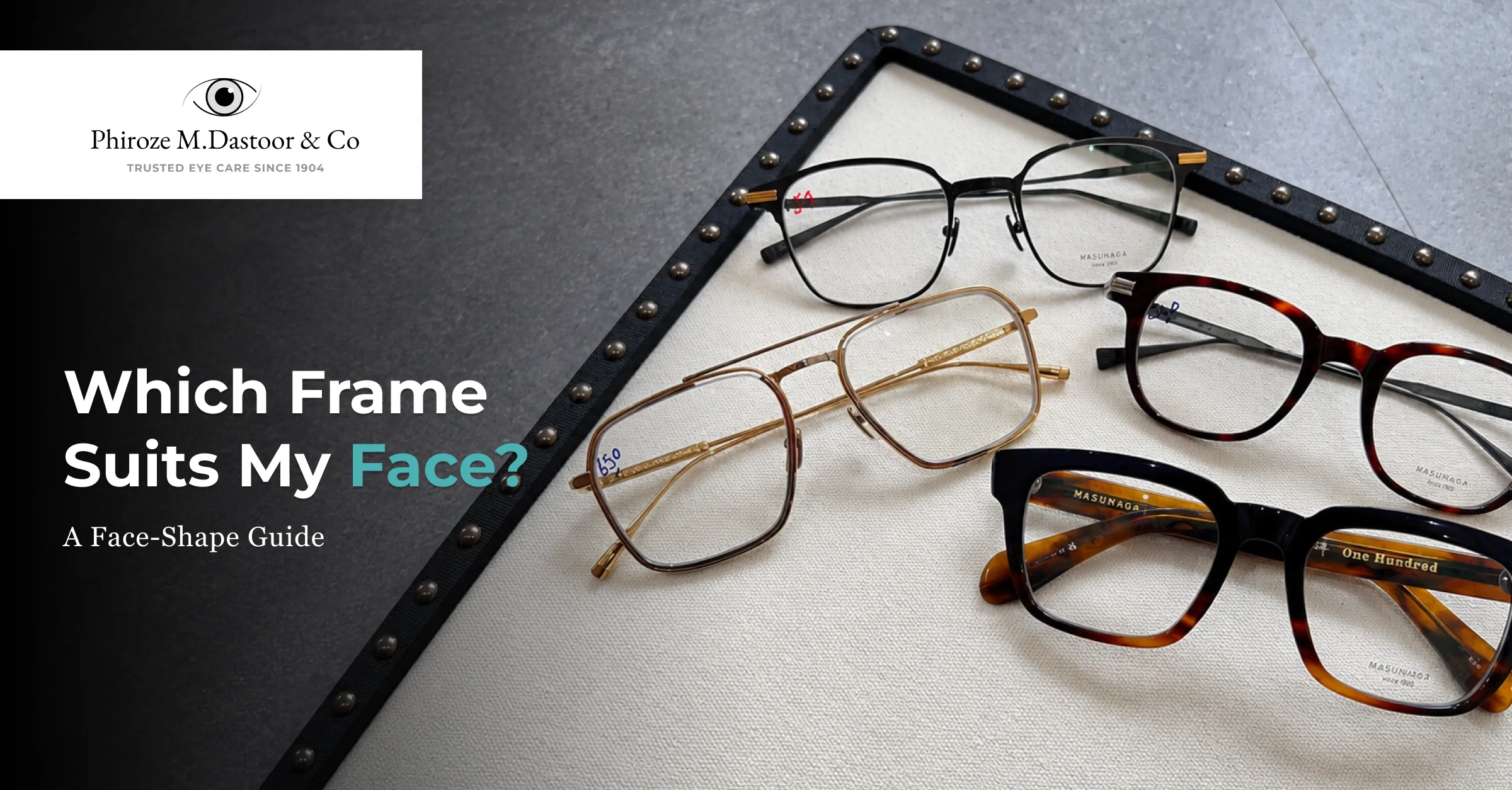
Glasses for Face Shape: Which Frame Suits My Face?
The idea is very simple. Pick a frame that gives contrast to the shape of your face. Given below points help you to understand glasses for each face shape-
Oval Face Shape Glasses
Oval face shape glasses are the easiest to choose. An oval face is well balanced. So most frame shapes look good on it. Rectangle and square and geometric frames add a little definition to soft features (NCOA). Cat eye frames also work well.
Choose a frame that is not narrower than the widest part of your face. Many opticians also say the top of the frame should follow your eyebrow line. Avoid frames that are too big. They can hide your face and slide down your nose.
Glasses for Round Face
A round face has similar length and width and a soft jaw. The rule here is contrast. Choose frames with angles to add structure to the face. Rectangle and square frames are the best choice for round face glasses. Oversized frames and frames with a square lens also work.
Glasses for Square Heart Diamond and Rectangle Faces
A square face has a strong jaw. Round and oval frames soften the sharp angles (NCOA). A heart shaped face has a wide forehead and a narrow chin. Oval and round frames and rimless frames suit it. Bottom heavy frames also balance the wide forehead.
A diamond face has wide cheekbones. Cat eye frames and oval frames and rimless frames show off the cheekbones. A rectangle or long face looks shorter with tall and oversized frames.
Do Not Forget About the Fitting of the Glasses
The frame should not be much wider than your face. It should not pinch your temples. It should not slide down your nose. Many people have a low or flat nose bridge. Their glasses slide down or touch the cheeks. Ask for low bridge fit frames or frames with adjustable nose pads. The label low bridge fit or Asian fit is only a shop term. It suits anyone with a low nose bridge (Glasses Direct).
Frames for a High Number
If your number is high choose a smaller frame. A nearsighted lens is thin at the centre and thick at the edge. A wide frame adds more of the thick edge. Light frames and thin high index lenses also help. Adjustable nose pads help heavy lenses stay in place. To know what your number means read our blog on how to read your eye prescription.
When to See a Doctor
See your optician if new glasses give you headache or eye strain or pain behind the ears or marks on the nose. A small adjustment often fixes this. See an eye doctor if your vision is blurry even with new glasses. Never buy glasses for style alone with the wrong number. Go to the hospital at once if you have a sudden fall in vision.
Frame Selection at Phiroze M Dastoor & Co
The team at Phiroze M Dastoor & Co can test your eyes and help you pick frames that suit your face and your prescription. We also check the fit and adjust the frame so that it sits well on your nose.
If you have not got your eyes tested for a long time you can visit your nearest Phiroze M Dastoor & Co and get a complete eye test done before you buy new frames.
Not sure what your prescription means?
Frequently Asked Questions (FAQs)
Which frame suits my face?
It depends on your face shape. Choose a frame that gives contrast. Angular frames suit round faces and round frames suit square faces.
What are the best oval face shape glasses?
Most frames suit an oval face. Rectangle and square and geometric frames add definition and cat eye frames also work well.
What are the best glasses for a round face?
Rectangle and square frames add angles to a round face. Oversized frames and frames with a square lens also work.
Which round face glasses should I avoid?
Avoid small round frames and very curvy frames. They repeat the roundness of the face.
How do I find my face shape?
Pull your hair back and look in the mirror. Find the widest part of your face and look at the jaw and the length. Pick the shape that looks closest.
Is face shape a strict rule for glasses?
No. It is only a guide. Fit and comfort matter more. Choose a frame you like and that sits well.
Which glasses suit a square face?
Round and oval frames soften the sharp jaw. A rounded rectangle is another option.
Which glasses suit a heart shaped face?
Oval and round and rimless frames suit a heart shaped face. Bottom heavy frames also balance a wide forehead.
Should I choose a big or a small frame for a high number?
Choose a small frame. It keeps the thick edge of the lens smaller and the glasses lighter.
References
National Council on Aging (NCOA). How to choose glasses for your face shape style and fit.
Glasses Direct. Asian-fit glasses: a guide to low-bridge-fit eyewear.
Sheeladevi S, Seelam B, Nukella PB, Borah RR, Ali R, Keay L. (2019). Prevalence of refractive errors uncorrected refractive error and presbyopia in adults in India: A systematic review. Indian Journal of Ophthalmology.