Summary
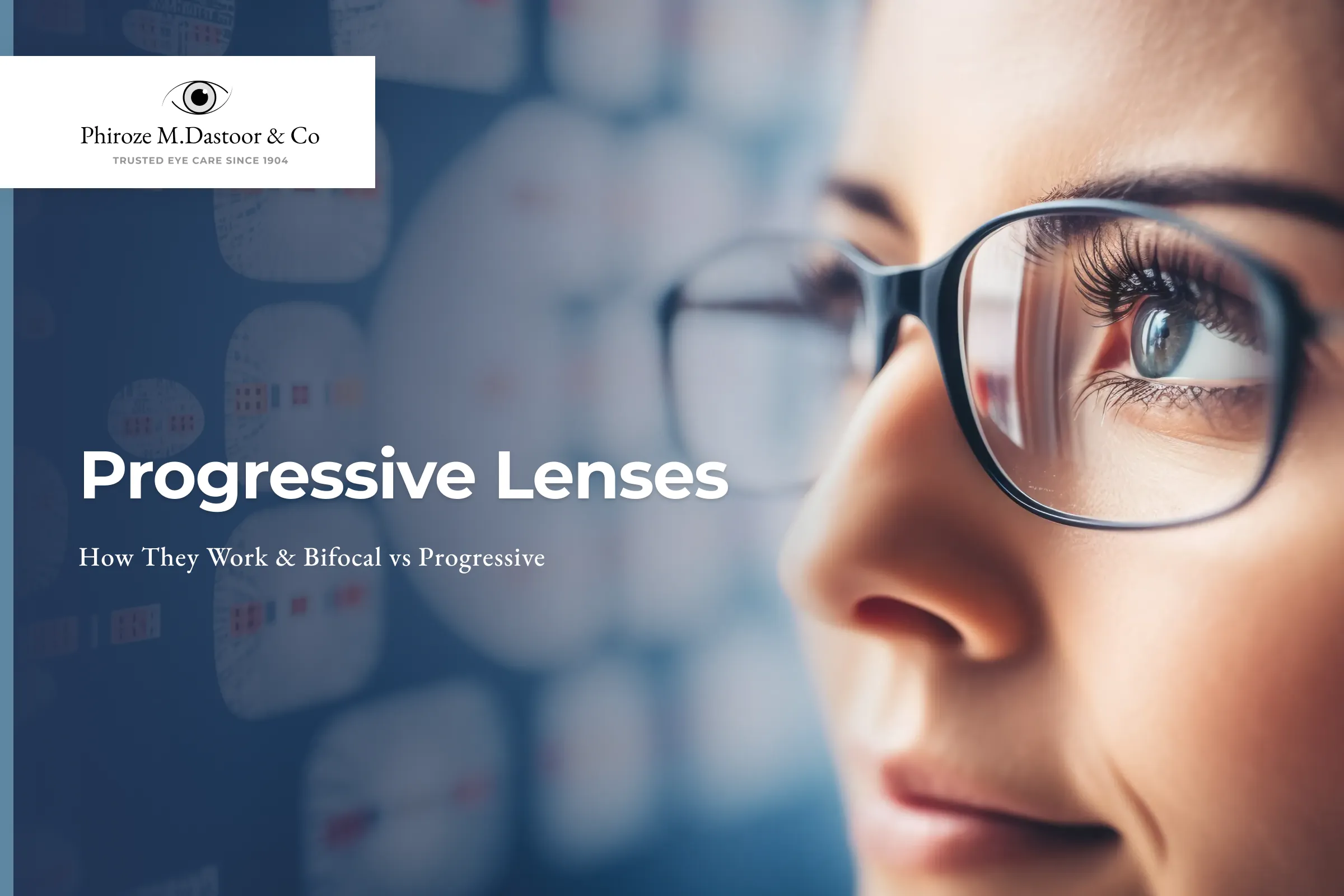
Progressive lenses let one pair of glasses cover distance, intermediate and near vision. Unlike conventional bifocals, there is no visible line across the lens because the prescription changes gradually. They can be convenient, but the fit and measurements matter, and they may take a little getting used to.
A common sign of presbyopia is that distance vision still feels fine while phone text, menus or labels become harder to read. Progressive lenses can bring more than one viewing distance into the same pair of glasses, so you do not have to keep changing between distance and reading pairs.
What are progressive lenses?
Progressive lenses are multifocal spectacle lenses. Instead of having one prescription across the whole lens, the power changes as you move down it.
That gives you different areas for different tasks. The upper part is generally used for distance, the middle for intermediate work such as a computer, and the lower part for reading and other close work.
They are also known as progressive addition lenses (PALs). Unlike conventional bifocals, there is no visible line between the viewing areas. The change from one power to another is gradual.
What does wearing progressive glasses feel like?
Your first few days in progressive glasses may feel different, especially if you have previously worn single vision lenses.
You may find yourself moving your head a little more at first or taking a moment to locate the clearest part of the lens for a phone, screen or distant object. This often feels more natural once you get used to the viewing zones.
How quickly that happens varies. Some people settle in almost straight away, while others need longer.
Why can peripheral vision feel different with progressive lenses?
The main viewing zones sit through the central part of a progressive lens. Towards the outer edges, vision can feel less clear because of the way the lens power changes.
You may notice this more when you first wear the glasses or when you glance sideways through the lens. If the blur is central, very uneven or continues to interfere with everyday use, have the prescription and fit checked.
What if your progressive lenses still feel uncomfortable?
It is common to need some time to adjust. But if the glasses still feel wrong, the blur persists or you are avoiding them because they are uncomfortable, have them checked rather than simply trying to push through.
Sometimes the issue is not the prescription itself. The measurements, frame position or fit may need reviewing, and a small adjustment can make a noticeable difference.
Why do fitting and measurements matter with progressive lenses?
With progressive lenses, the prescription is only part of the story. The viewing zones also have to sit in the right place in front of your eyes, which is why fitting measurements matter.
The main fitting points include:
- Pupil distance: helps align the lenses with the position of your eyes.
- Fitting height: helps position the viewing zones correctly within the frame.
- Frame position: how the frame sits on your face can affect where you look through each zone.
- Frame shape and fit: can affect the usable lens area, so measurements should be checked again if you change frames.
A personalised eye examination can confirm your prescription and help the team understand how you use your vision day to day.
Bifocal vs progressive lenses: what is the difference?
| Feature | Bifocal lenses | Progressive lenses |
| Vision zones | Distance and near | Distance, intermediate and near |
| Visible dividing line | Usually visible | No visible line |
| Power change | Moves between separate areas | Changes gradually through the lens |
| Typical use | Mainly distance and near tasks | Useful when moving between several viewing distances |
Which option fits you better depends on the distances you use most, your prescription, what you have worn before and what feels comfortable for you.
Progressive lenses vs reading glasses: what is the difference?
The main difference is what each option is designed to do:
- Reading glasses: mainly for close work such as books, menus or phones.
- Progressive lenses: cover distance, intermediate and near vision in one pair.
- Which may suit you: depends on your prescription and whether you regularly move between close work, screens and distance tasks.
Why do progressive lenses vary in cost?
Prices vary because progressive lenses are not one standard product. The design, level of personalisation and lens material can all differ, so two people with similar prescriptions may not be offered the same option.
Price can be affected by:
- Lens design
- Level of personalisation to your prescription and measurements
- Lens material
- Added treatments or coatings
- Frame and fitting requirements
Rather than choosing on price alone, the important part is whether the lens suits your prescription, frame and everyday visual routine.
Comparing progressive lens options?See the spectacle lens options available at Phiroze M. Dastoor & Co. and find out which may suit your needs.
What should you consider when choosing progressive lenses?
Start with how you use your vision during the day. Your prescription matters, but so do the distances you use most often.
If you spend long periods reading or working on a computer, your needs may be different from someone who mainly uses their glasses for distance vision and occasional close work.
It also helps to consider what type of glasses you currently wear. Moving from single vision lenses can feel different from changing from bifocals. [PLACEHOLDER LINK: link “single vision lenses” to the Types of Lenses for Glasses blog once published]
Frame fit matters too, because progressive lenses need to sit in the correct position in front of your eyes. Rather than looking for one “best” progressive lens, the aim is to find an option that works well with your prescription, everyday activities and comfort.
Are progressive lenses right for you?
Progressive lenses can be useful if you need correction at more than one viewing distance and would prefer to use a single pair of glasses. However, they are not the only option.
What works well for one person may not suit another. Your prescription, the way you use your vision and how the lenses are fitted can all help determine whether progressive lenses are a suitable choice for you.
Considering progressive lenses?Speak with the team at Phiroze M. Dastoor & Co. about the spectacle lens options available for your needs.
FAQs
Can progressive lenses be used for computer work?
Yes. Progressive lenses include an intermediate area that can be used for tasks such as working on a computer. If you spend many hours at a screen, mention this when your lenses are being selected so your usual working distance and visual needs can be considered.
Can every frame be used with progressive lenses?
Not every frame is suitable. Progressive lenses need enough space for the different viewing zones and must sit accurately in front of your eyes. The frame choice therefore depends on both the lens design and your individual measurements.
References
American Academy of Ophthalmology (2026) What Is Presbyopia?
Garcia-Espinilla, O., Gallegos-Cocho, I., Sanchez, I., Cañadas, P. and Martin, R. (2022) ‘Comparison of physiognomy and frame angle parameters using different devices to prescribe progressive addition lenses’, Clinical and Experimental Optometry, 105(4), pp. 420–427.
Garcia-Espinilla, O., Sanchez, I. and Martin, R. (2023) ‘Visual satisfaction with progressive addition lenses prescribed with novel foveal fixation axis measurements’, Scientific Reports, 13, 11262.
Li, J., Wu, Y. and He, M. (2026) ‘Design of Progressive Addition Lens for Presbyopia: A Systematic Review’, Ophthalmic and Physiological Optics, 46, pp. 395–403.
National Eye Institute (2019) Eyeglasses for Refractive Errors.